
Post No. 004. About 8 minutes to read.
Credibility Before Persuasion: Why I Check Whether You Are Trusted First
By Johnson Joel Sonayon (JJS), Digital Marketing & Growth Specialist, Lagos, Nigeria. Published .
How to see your business through a stranger’s eyes before you try to convince anyone.
In short: your biggest competitor is not another business. It is the doubt in a stranger’s mind. Everything below is about removing it, by checking whether you are trusted before you try to persuade anyone.
Music plays while you read. Use the round button and the slider at the bottom left to pause it or change the volume. This post is interactive. Tap the buttons and tick the boxes.
A woman runs a small catering business. Strangers find her every week. Her posts reach them, her name comes up in chats, and people land on her page.
Most of them leave without a word.
She decides the problem is her prices, so she lowers them. Nothing changes. She decides she is not posting enough, so she posts more. Nothing changes.
Her food was never the problem. A stranger looked at her page, could not answer one quiet question, and moved on. The question was: “Can I trust this?”
Here is the idea I want you to keep from this blog. Your biggest competitor is not another business. It is the doubt in a stranger’s mind. Everything below is about removing it.
Last time, I said visibility brings people to your door. Credibility decides whether they walk in.
The Trust Gap
Every business has two sizes. How good it really is, and how good it looks to someone who has never met it.
The distance between the two is the trust gap.

 Credibility Before Persuasion · Blog 004
The trust gap is the distance between how good you are and how good you look to a stranger.
An excellent business with a confusing page can lose people to an average one that looks clear. Tap each business to see what a stranger does.
It is unfair, but it is fixable. The painful part is that strangers never tell you. They just leave. So the first job is to see what they see.
The Five Silent Questions
A stranger needs five yeses before they message you. They never say them aloud. They answer them in seconds, and one no is often enough to leave.
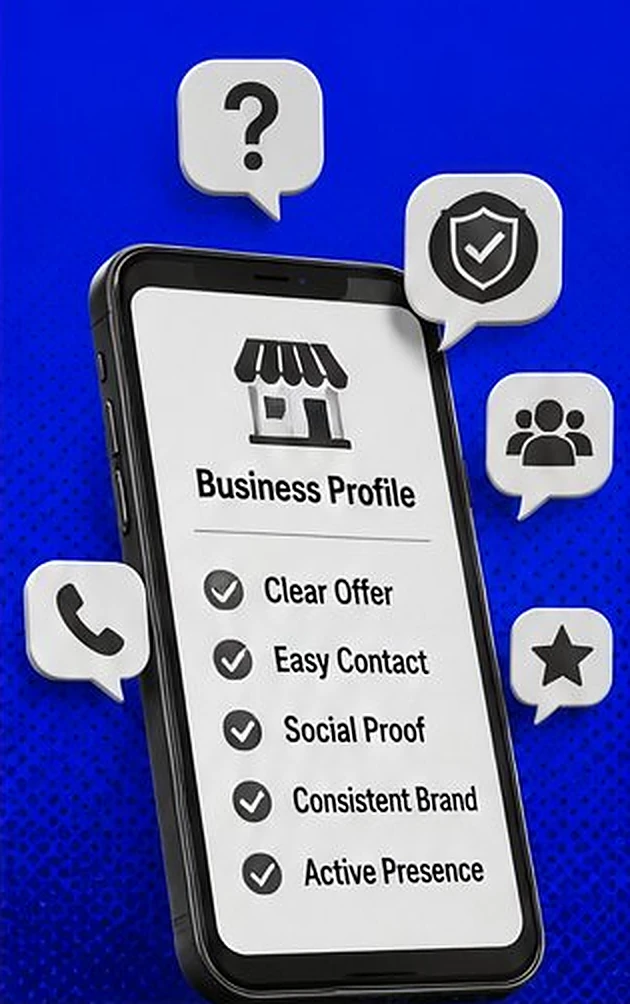
Tap each question.
Question 1: Do I understand what they offer?
What the stranger sees when the answer is no: “We deliver quality solutions tailored to your needs.” It sounds fine and says nothing.
The fix: write one plain sentence. I help WHO get WHAT, in WHERE or through HOW. For example: “I bake custom celebration cakes for birthdays and weddings in Lagos.” Put it where a stranger looks first.
The test: say your sentence to someone outside your business. If they can repeat it back, it works.
Question 2: Can I reach them without effort?
What the stranger sees when the answer is no: contact details buried in an old post, a link that goes nowhere, a “DM for price” that never gets answered.
The fix: choose one main way to be reached, put it where the eye lands first, and make sure it works.
The test: on your phone, count the taps it takes to reach yourself. Fewer is better.
Question 3: Is there proof that others trust them?
What the stranger sees when the answer is no: claims with nothing behind them. Anyone can write “we are the best.” The next sections show how to build real proof, even if you have no customers yet.
Question 4: Do they look the same everywhere?
What the stranger sees when the answer is no: one name on Instagram, another on Facebook, a third on the flyer, and a different description on each. They quietly wonder which version is true.
The fix: choose one name, one short description and one set of contact details, and use them everywhere. This also helps search engines and AI tools describe your business correctly.
The test: search your own business name. Do the first results tell the same story?
Question 5: Do they look alive?
What the stranger sees when the answer is no: a last post from months ago and comments nobody answered. They wonder if you are still in business.
The fix: you do not need to post daily. You need to look alive. Post at a pace you can keep, reply to comments, and remove or update anything outdated.
The test: tap your last post. If it is old, a stranger is asking, “Are they still open?”
Your Reply Is Your First Proof
Here is something most people miss. The moment a stranger messages you, they are still testing you.
A slow reply, a careless reply or a copy-and-paste reply can undo everything your page built. A warm, clear, quick reply can do more for trust than any design.
So treat the first reply as part of your credibility, not as customer service afterwards.
The Proof Ladder
Proof has rungs. Here they are, from weakest to strongest. Tap each rung.

Rung 1: Claims
“We are the best.” Anyone can say this.
Rung 2: Credentials
Training, certificates and experience, stated plainly and truthfully.
Rung 3: Process
How you work, step by step. People trust what they can picture.
Rung 4: Samples
Real work that people can see.
Rung 5: Customer words
A real comment from a real customer, shared with their permission.
Rung 6: Customer results
A specific, true outcome that a customer is happy for you to share.
Credibility Before Persuasion · Blog 004Proof has six rungs. Climb one at a time. Never claim a rung you have not reached.
If you have no customers yet, you are not stuck. Rungs 2, 3 and 4 are yours to build today.
When you are ready for rung 5, ask simply: “Would you be happy to share one honest sentence about working with me? I will only post it if you say yes.”
One more thing builds trust faster than people expect. Plain limits. Saying “I do not do same-day orders” or “I work with small businesses only” makes everything else you say easier to believe.
Small Things That Quietly Cost Trust
Tick any that are yours.
None of these looks serious alone. Together they say, “Nobody is paying attention here.” Every one of them is free to fix.
The Ten-Second Test
You do not have to guess how strangers see you. Test it.

Find someone who does not know your business well. Show them your page for ten seconds. Take it away. Then ask three questions:
What does this business do?
Who is it for?
How would you contact them?
Compare their answers with what you would say. Every difference is part of your trust gap. This test costs nothing, and it often surprises the owner.
Your Trust Score
Now score yourself. Answer yes or no to the five silent questions for your own business, and count your yeses. Tick every question you can answer yes to.

Five yeses: your foundations are strong. Keep them alive.
Three or four: you are one or two fixes away from a real difference.
Zero to two: do not spend more on reach yet. Fix trust first, because more visitors will only meet the same doubt.
Credibility Before Persuasion · Blog 004Fix before you spend. More visitors to an untrusted page only means more people leaving.
For a deeper look, take my free Trust Check app on my Updates Hub. It asks 12 questions about the clarity of your offers, your contact information, your proof and reviews, how consistent your brand looks, your business information and your general presentation. Then it recommends what to improve.
The Order of Repair: A Five-Day Plan
Do not fix everything at once. Fix in the order a stranger meets it, one step a day.
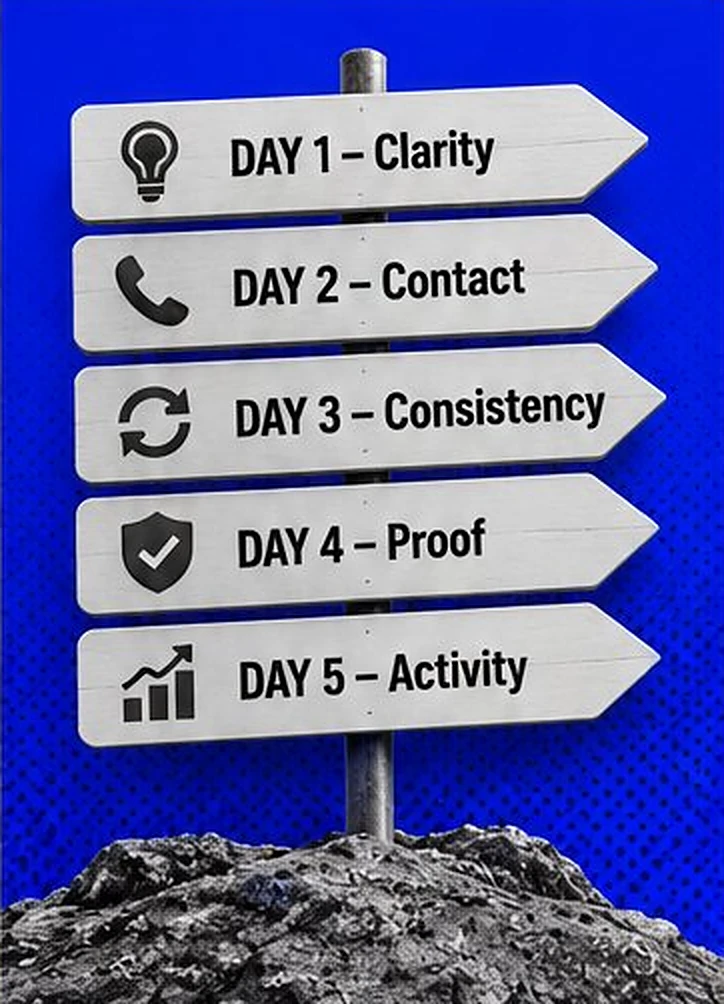
Day 1, clarity.
Locked until the step above is done.
Write your one plain sentence and put it where people look first.
Day 2, contact.
Locked until the step above is done.
Choose your main way to be reached and test it yourself.
Day 3, consistency.
Locked until the step above is done.
Match your name, description and details everywhere.
Day 4, proof.
Locked until the step above is done.
Add one honest piece of proof from the ladder.
Day 5, activity.
Locked until the step above is done.
Reply to every open comment and message, and remove what is outdated.
The order matters because each step makes the next one count. Proof on a confusing page is wasted. Activity with no clear contact leads nowhere.
How to Know It Is Working
Start with one habit. Every time someone becomes a customer or sends an enquiry, ask: “What made you decide to contact me?” Then ask: “Was there anything that made you hesitate?”
Write the answers down. Tap each question to see what it shows you.
Another sign is the kind of messages you receive. When trust improves, people stop asking “Are you real?” and start asking “How do I order?”
Where This Leads
Imagine your business is now found and trusted. A stranger believes you. They want what you sell.
Then they hesitate at the last step, think about it, and never come back.
Trust brings people to the edge of a decision. It does not carry them across. Believing you is not the same as choosing you.
Blog 005 goes live on Sunday, 22 November, on my Updates Hub. It shows what to check when a trusted business still loses people at the last step. It picks up exactly where this one ends, so come back with your Trust Score.
A Word of Thanks

You gave this blog the most valuable thing you have, your time. Thank you.
I did not write it to impress you. I wrote it so you could leave with something to use before today ends.
If it helped, pass it to one business owner who needs it. If something is unclear, ask me, and I will reply to you personally.
I am glad you were here.
Johnson Joel Sonayon
Digital Marketing & Growth Specialist
Take your next step
Start the free Trust Check, go back to my Updates Hub, or see what I do.
Keep reading

Questions or thoughts?
If something in this post made you think, tell me. I read every message.